
GC Injection Systems
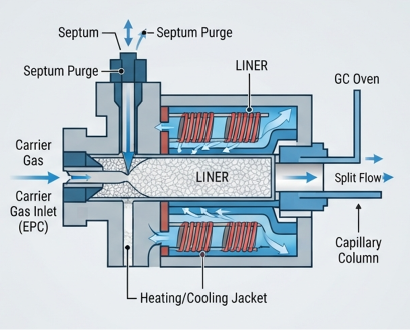
Programmed Temperature Vaporization (PTV) Injectors
Principle – A rapidly heatable / coolable inlet gives flexible split, splitless or solvent-vent operation.
Mechanism – Sample enters a cold liner; the liner is then flash-heated to transfer analytes onto the column, or solvent is vented before heating for large volumes.
Uses – Large-volume injection, thermolabile compounds, solvent elimination.
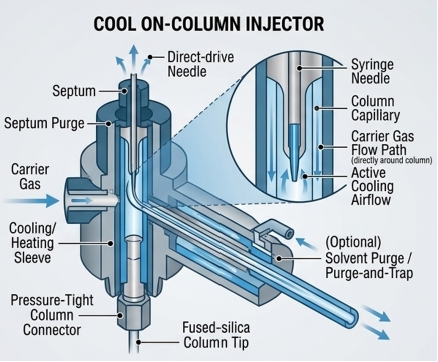
Cool On-Column (COC) Injectors
Principle – Liquid sample is placed directly inside the column at low temperature, avoiding vaporization bias.
Mechanism – A fine syringe needle deposits sample straight into the cool column inlet; the oven is then temperature-programmed to elute it.
Uses – Thermally labile, high-boiling or trace analytes needing minimal discrimination.
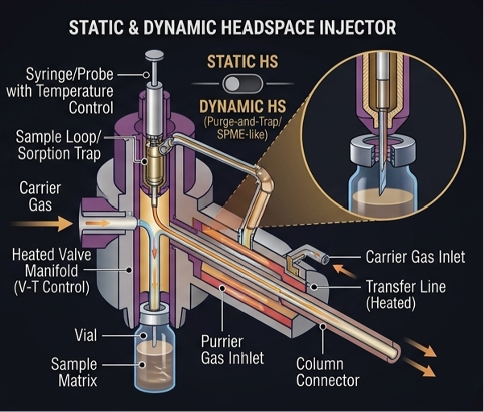
Headspace Samplers
Principle – Analyzes the volatile fraction that equilibrates in the gas space above a liquid or solid sample.
Mechanism – A sealed vial is heated to equilibrium; a gas-tight syringe or automated valve withdraws headspace vapor and injects it into the GC.
Uses – Volatiles in matrices unsuited to direct injection — beverages, blood, polymers.
GC Detector Systems
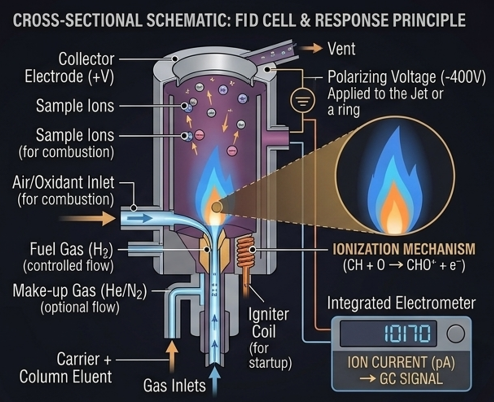
Flame Ionization Detector (FID)
Principle – Organic compounds burned in a H2/air flame generate ions in proportion to reduced-carbon content.
Mechanism – Column effluent mixes with H₂, burns at a jet; ions formed are collected at a bias electrode, producing a current that is amplified.
Selectivity – Near-universal for hydrocarbons; blind to water, CO₂ and permanent gases.
Thermal Conductivity Detector (TCD)
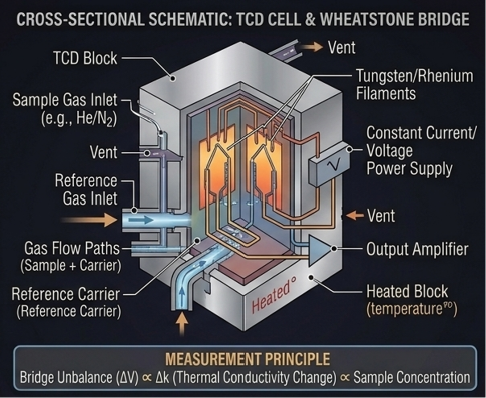
Principle – Measures the change in carrier-gas thermal conductivity caused by the presence of analyte.
Mechanism – A heated filament in a Wheatstone-bridge circuit cools differently when analyte-laden gas passes it versus a reference; the resistance change is the signal.
Selectivity – Universal, non-destructive; ideal for permanent gases (needs He/H₂ carrier).
Electron Capture Detector (ECD)
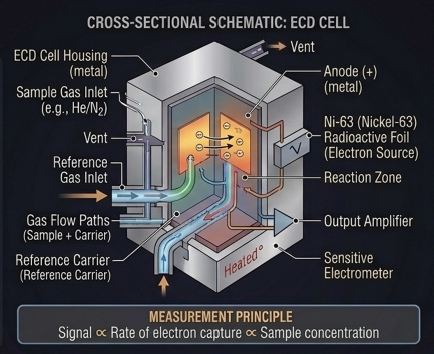
Principle – Electronegative compounds capture free electrons from a radioactive β-source, lowering a steady current.
Mechanism – A ⁹⁵Ni foil ionizes N₂ carrier gas to create a constant electron current; analytes that capture electrons cause a measurable drop.
Selectivity – Extremely sensitive to halogenated, nitro and conjugated-carbonyl compounds.